Tuesday, August 24, 2010

Don't surf the web or play video games at school.

From the NY Times:

Your Brain on Computers


Digital Devices Deprive Brain of Needed Downtime
 
 
[me:] We are just not being fair to our students unless we confront the new digital distractions....
 

Sunday, August 22, 2010

Scary! Negroponte admits to shortened attention span while reading.

From the NY Times

Attention spans evolve and shorten, as even the most skilled media jugglers can attest. “I love the iPad,” admits Mr. Negroponte, “but my ability to read any long-form narrative has more or less disappeared, as I am constantly tempted to check e-mail, look up words or click through.” And people, every bit as much as technology, shape the churning media ecology.

Saturday, August 21, 2010

A balanced diet for 'screen time'

Although we've had TV for a while now, other forms of passive entertainment like video games, the internet, and portable 'screen devices' (e.g. cellphones, gameboys, iPads) are relatively new.  And educators and parents are trying to figure out where they fit in.

With respect to food, there is a clear understanding now among professionals about the elements of a good diet, and and which elements of food lead to ill-health when taken to excess.  It is not an easy task, but government agencies are constantly working on developing guidance to consumers - especially through labeling of nutritional information.

If one now turns to the 'infotainment' diet that the average middle- and high-schooler snacks on all day, I am really hard-pressed to find any guidance (from any source) that is useful to parents or teachers.  Recommendations from the AAP (American Academy of Pediatrics) on maximum weekly limits for screen-time are a start, but they aren't much better than saying 'too much sugar is bad for you.'

We really need to focus on developing a concept of a balanced diet for digitally-mediated, non-human-to-human interactions.  And we don't have the luxury of 10 years to get going.  Or we will have to deal with a whole generation of 'obese' (in the brain) adults who are stuck with the bad snacking habits from their youth.

Monday, July 19, 2010

Digital .... [Diplomacy]

From the NY Times magazine
Digital Diplomacy
By JESSE LICHTENSTEIN

Published: July 12, 2010

A very interesting piece about two young State Department staff who use Twitter.  I saw some useful parallels with the utilization of emerging digital technologies in the classroom.

Two quotes that capture what I like about this article.

“The problem with his thinking,” he said, “is it neglects the inevitability that this technology is going to spread — so he advocates a very dangerously cautious approach that says it’s dangerous and we shouldn’t play in that space. What the Evgeny Morozovs of the world don’t understand is that whether anybody likes it or not, the private sector is pumping out innovation like crazy.”


“All of these tools can be utilized by individuals for .... negative purposes” ...  “but that technology isn’t going anywhere. So we can fear we can’t control it and ignore the space, or we can recognize we can’t control it, but we can influence it.”

Friday, March 19, 2010

The need for play

One can't open a periodical these days without being confronted with new evidence for the importance to children of 'free play.'  Play seems to a strong evolutionary imperative.

Two articles in Scientific American caught my attention while I ate lunch today.


1.  The Serious Need for Play.
But in the 42 years since,  Stuart Brown has interviewed some 6,000 people about their childhoods, and his data suggest that a lack of opportunities for unstructured, imaginative play can keep children from growing into happy, well-adjusted adults. 
I'll come back to Brown in a moment, but first....

2.  The Ethical Dog.

Professor Marc Bekoff argues that studying play in canids (dogs, wolves, coyotes) can teach us a lot about human socialization.

Morality, as we define it in our book Wild Justice, is a suite of interrelated other-regarding behaviors that cultivate and regulate social interactions. These behaviors, including altruism, tolerance, forgiveness, reciprocity and fairness, are readily evident in the egalitarian way wolves and coyotes play with one another. 

Here are 4 rules that Bekoff and his students have discerned by video-taping and studying canids playing.

a.  Communicate clearly when you want to play (and not fight).  You are agreeing to a stylized set of rules.

b. Mind your manners. Animals consider their play partners’ abilities and engage in self-handicapping and role reversing to create and maintain equal footing.

c. Admit when you are wrong. After hurting a play-mate, send a message, “Sorry I bit you so hard—this is still play regardless of what I just did. Don’t leave; I’ll play fair.”

d.  Be honest.Individuals who continue to play unfairly or send dishonest signals will quickly find themselves ostracized. This has far greater consequences than simply reduced playtime; for instance, Bekoff’s long-term field research shows that juvenile coyotes who do not play fair often end up leaving their pack and are up to four times more likely to die than those individuals who remain with others.
 
The last rule is especially striking - since Stuart Brown's research (The need for serious play, above) all began with the study of convicted murders, drunk drivers and other violent individuals.

When he left clinical medicine in 1989, Brown began to investigate PLAY, and in 2009 founded the National Institute for Play


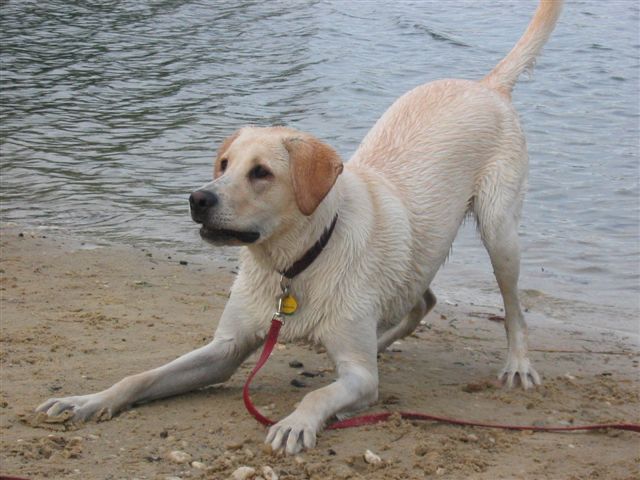
Before you watch this wonderful slide-show of a polar bear and a husky dog playing, read The Ethical Dog article so you can understand the role of the 'bow' in canid play (see image above). 

Or just Listen to Stuart Brown (TED, 2008) tell the story, and talk about PLAY.

Thursday, March 18, 2010

Math Curricula

It seems likely that there will soon be what amounts to a national K-12 curriculum in Math - thanks to the 46 states and District of Columbia who joined together on the  Common Core State Standards Initiative  via the Council of Chief State School Officers (CCSSO) and the National Governors Association (NGA).

Common Core State Standards for Mathematics is a draft that was released for public comment

The National Council of Teachers of Mathematics has its own set of standards.

The National Science Foundation sponsors its own website to assist schools.


Of the three sites, I find myself leaning towards NCTM (at least at present)

Tuesday, March 9, 2010

Lemov’s Taxonomy

Elizabeth Green writes a very thought-provoking piece in this Sunday's NY Times Magazine.  Building a Better Teacher

Two of the main themes are

1.  Doug Lemov’s Taxonomy. (“Teach Like a Champion: The 49 Techniques That Put Students on the Path to College.”)  Central to Lemov’s argument is a belief that students can’t learn unless the teacher succeeds in capturing their attention and getting them to follow instructions.

2.  Deborah Loewenberg Ball's idea of Mathematical Knowledge for Teaching, or M.K.T.  Mathematicians need to understand a problem only for themselves; math teachers need both to know the math and to know how 30 different minds might understand (or misunderstand) it.  (The same would apply to reading, spelling, etc.)  Ball says that at the heart of M.K.T. is an ability to step outside of your own head. “Teaching depends on what other people think, not what you think.”


Together these two themes suggest that teaching is an extremely specialized skill/occupation.  This is, of course, encouraging for teachers who want to be better.  However, it points in a ominous direction for the economics of education.  For this can only mean that education is going to get even more expensive.  Education seems to be one field that has no notion of 'productivity.'   In many ways it seems to be either a very artisanal enterprise, or an industrial one.  The former is expensive.  The latter suffers from very poor quality.

Children are curious and creative. (Science and Art)

One commonly hears that children enter the school system naturally creative.  But by the time they graduate, we somehow manage to squeeze it out of them.

I am currently substitute-teaching in middle-school science, and am seeing a corollary.

Children enter the school system naturally curious about the world.  i.e  They make good scientists.  But by the time they graduate we somehow manage to squeeze it out of them.

Of course, they don't have many of the skills needed to 'carry out' science.  But, similarly, they don't have many of the techniques and vocabulary in the arts.  That's why we teach art in school.

Sunday, February 28, 2010

Preparing for the Marketplace of Ideas

A lot of the buzz around the idea of a nation like the United States being competitive in the 21st century, has to do with 'fostering creativity' or 'having intellectual capital'.  The implication, of course, is that the education 'system' ought to be preparing our citizens for this new future.

Here's an article from the  NY Times that gives a glimpse of what this new economy might look like - The “entrepreneur in residence” making $10,000 to $15,000/month.

6 Months, $90,000 and (Maybe) a Great Idea


“We kind of had an epiphany,” says Phil Siegel, an Austin partner. “The competition and the need for talented people is in some ways a lot harder than the competition for deals.”

While the expectations are high for his ideas, Mr. Bauer maintains that the E.I.R. programs work precisely because failure is allowed in Silicon Valley.


“In other parts of the world, there is a big stigma on your résumé if you try and fail,” he said. “That doesn’t happen here. Instead, people like the E.I.R.’s are ready to keep on taking swings.”


There is, no doubt, something to be said for all this. Except that everything I keep seeing suggests a handful of wildly successful people (at any one time) sustaining the wealth of a nation of 300 million people. It seems inefficient to me (at least at this point) to build an entire education system around the notion that every decade or so, in select industrial/economic sectors, a pair of entreprenuers (like those that founded Google or Microsoft) will bring into being the next 'big thing.'


Are the other 80-100 million (at the very least) potentially productive adults going to sit around drinking beer and watching TV?

Sunday, February 21, 2010

Career-change from PR to teaching English.

A Midstream Switch to Teaching - http://www.nytimes.com/2010/02/21/jobs/21pre.html


I like the matter-of-fact way in which Peter Wilson tells, in the NY Times, of his switch from account manager in public relations to teaching seventh-grade English.

No uplifting, heart-warming story here.  But I think it begins to point at the type of personality who will enjoy a career-change to teaching.

Sunday, February 14, 2010

Cosmic Goosebumps


A few streams merged a few minutes ago to give me a serious case of goose bumps, and a few sentimental tears.

1.  A few weeks ago my 7th & 8th science students watched Al Gore's "An Inconvenient Truth."  [We were discussing visual display of information to make a point.]  In that movie, Gore shows a picture of Earth - commonly titled 'Pale Blue Dot' - taken from 4 billion miles away by the Voyager 1 spacecraft in 1990. 


2.  We have mid-winter break next week, and the assigned reading the students are taking home is "Twilight At Easter" - which is a chapter from Jared Diamond's gripping book "Collapse."  [please read the book if you have not yet.  We are looking at it to create a graphic/poster that summarizes the information in the chapter]  In this chapter Diamond traces the evidence, as best as we understand it, for the rapid collapse of the society on Easter Island - the eastern most tip of Polynesia, and probably the last to be settled. Diamond's conclusion is that the residents of the island rapidly depleted its resources while making those striking moai (statues) and ahu (platforms) on which they stood.  Once the wood ran out, the islanders could no longer make ocean going canoes, and they were stuck, with their traditional sea-based sources of protein drying up.


Of course, Diamond and Gore are making very similar points about what may be happening right now on Earth.

That's the background.  Now the goose bumps.

3.  While reading* the news this morning (it is quiet, and no one else has woken up yet) I came across this article on the NPR website about the taking of that photograph that Gore used;  this week is apparently the 20th anniversary of that photograph.  Carl Sagan was instrumental in getting that photograph taken; NASA was initially not interested as it had no scientific value.  [*I have not yet heard the audio story, as it is set to run on tonight's All Things Considered.]

Here is what Sagan says of the pale blue dot, in his book Pale Blue Dot

Look again at that dot. That's here. That's home. That's us. On it everyone you love, everyone you know, everyone you ever heard of, every human being who ever was, lived out their lives. The aggregate of our joy and suffering, thousands of confident religions, ideologies, and economic doctrines, every hunter and forager, every hero and coward, every creator and destroyer of civilization, every king and peasant, every young couple in love, every mother and father, hopeful child, inventor and explorer, every teacher of morals, every corrupt politician, every 'superstar,' every 'supreme leader,' every saint and sinner in the history of our species lived there — on a mote of dust suspended in a sunbeam.


[Al Gore was being poetic when he referred to the dot as one pixel; it was actually maybe 6.  Sagan is being poetic about the sunbeam; as the  NPR piece says, it was actually a stray reflection from the spacecraft.]
 
4.  It's Valentine's day this weekend, and the news media feel obliged to run stories about love.  NPR's Morning Edition ran a story from RadioLab that tells us of the blossoming love affair between Carl Sagan & Ann Druyan in 1977 as they worked on the audio-mix that was to go into outerspace on Voyager. 


The last two items alone are so powerful - bracketing as they do two ends of the Voyager mission. One eagerly looking out into the cosmos. The other wistfully looking back one last time.


In the 20 years since that picture was taken, we've finally begun to glimpse the damage we are doing to our 'Pale Blue Dot' and individuals and groups around the world are doing their best to turn the super-tanker around.

Diamond, in that chapter on Easter Island, asks the question (I'm paraphrasing) "What was the person who cut down the last tree on Easter thinking as he or she did that?" That question has hung with me ever since I first read Collapse.

Re-reading it again this week, I keep asking myself, did the residents of Easter even know there were other humans? If the scientific elite had thought to send a message out into their cosmos, what would they have said? I somehow doubt if they would have even mentioned why the moai were so important to them. I'm guessing that the importance of the moai was so great that it did not even bear mentioning. To explain a God rationally is to acknowledge it is a false god.

And bang!, this morning in the space of one hour I hear of the audio-mix we humans sent out more than 30 years ago, and I read about and see the picture that makes Earth's isolation pale in comparison to Easter's (do look up Easter in a zoom-able online map). And I wonder what would happen if some intelligent life-form ever came upon the Voyager spacecraft, traced it to back to Earth, and then one of them wrote a book about us. What would they describe as our moai that were ultimately responsible for our resource depletion and our society's collapse? What would they say our 'last tree' was? Would they ever figure out what we were thinking?

What we sent out on the Voyager spacecraft is so blissfully unaware of what is to come less than two decades later. In the NPR piece Ann Druyan talks about her brain waves that were recorded for the Voyager project, and how her overwhelming feeling that summer was of being in love. It is so touching to think that the first impression any extra-terrestrial society formed of us would involve that central human emotion.

Yet, Global Warming was already upon us. The early science was beginning to be accepted when Voyager set sail. By 1979 there was a tepid scientific consensus that we'd see the effects by the end of the century. In 1988 the IPCC was formed. Even before Voyager had left solar system our solar system, everything had changed.

To think that Ann Dryuan's and Carl Sagan's children - the incarnation of that love story from the summer of 1977 when their parents worked together on an audio-mix for an unknown intelligence - may live to see sea-level rises that change the shapes of our societies and the relationships between our countries.

It gives me the shivers, it really does.


[I find it fascinating how the 4 threads mentioned above came in 4 different media - DVD, print book, internet news, over-the-air radio.]

Tuesday, February 9, 2010

Creating buzz? Inspire awe, at a large scale

Will You Be E-Mailing This Column? It’s Awesome

I have not posted for a while, due a change that's been making different demands on my time. 

Since the begining of January, I have been working as a long-term Sub, teaching science to 7th and 8th graders, and a weekly hour of 'health' to 6th graders.  It is a lot of fun.

One of the new things is that I am learning to see the world through the eyes of 11-15 year-olds.  Hence this article by John Tierney in the NY Times caught my attention.  (btw, I do enjoy Tierney...)

Understanding the digital generations' approach to social networking is certainly getting everyone's attention these days; researchers at UPenn included, it seems.  They studied the most-e-mailed articles on the NY Times website over a six-month period.  (well, it is not clear to me that the NY Times readership is part of a 'digital generation', so extrapolation of these results to teenagers is purely mine)

Here's what caught my attention

Building on prior research, the Penn researchers defined the quality as an “emotion of self-transcendence, a feeling of admiration and elevation in the face of something greater than the self.”


They used two criteria for an awe-inspiring story: Its scale is large, and it requires “mental accommodation” by forcing the reader to view the world in a different way.


“It involves the opening and broadening of the mind,” write Dr. Berger and Dr. Milkman, who is a behavioral economist at Wharton.


Whereas 20% of the articles on the Home page made the cut, by the above definition, 30% of the articles in the Science page qualified. 


That's pretty encouraging for a science teacher, notwithstanding the multiple sources of possible bias in these findings.