Friday, March 19, 2010

The need for play

One can't open a periodical these days without being confronted with new evidence for the importance to children of 'free play.'  Play seems to a strong evolutionary imperative.

Two articles in Scientific American caught my attention while I ate lunch today.


1.  The Serious Need for Play.
But in the 42 years since,  Stuart Brown has interviewed some 6,000 people about their childhoods, and his data suggest that a lack of opportunities for unstructured, imaginative play can keep children from growing into happy, well-adjusted adults. 
I'll come back to Brown in a moment, but first....

2.  The Ethical Dog.
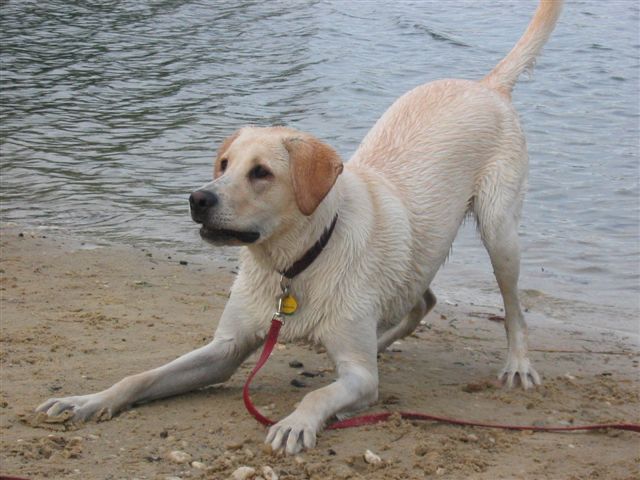
Professor Marc Bekoff argues that studying play in canids (dogs, wolves, coyotes) can teach us a lot about human socialization.

Morality, as we define it in our book Wild Justice, is a suite of interrelated other-regarding behaviors that cultivate and regulate social interactions. These behaviors, including altruism, tolerance, forgiveness, reciprocity and fairness, are readily evident in the egalitarian way wolves and coyotes play with one another. 

Here are 4 rules that Bekoff and his students have discerned by video-taping and studying canids playing.

a.  Communicate clearly when you want to play (and not fight).  You are agreeing to a stylized set of rules.

b. Mind your manners. Animals consider their play partners’ abilities and engage in self-handicapping and role reversing to create and maintain equal footing.

c. Admit when you are wrong. After hurting a play-mate, send a message, “Sorry I bit you so hard—this is still play regardless of what I just did. Don’t leave; I’ll play fair.”

d.  Be honest.Individuals who continue to play unfairly or send dishonest signals will quickly find themselves ostracized. This has far greater consequences than simply reduced playtime; for instance, Bekoff’s long-term field research shows that juvenile coyotes who do not play fair often end up leaving their pack and are up to four times more likely to die than those individuals who remain with others.
 
The last rule is especially striking - since Stuart Brown's research (The need for serious play, above) all began with the study of convicted murders, drunk drivers and other violent individuals.

When he left clinical medicine in 1989, Brown began to investigate PLAY, and in 2009 founded the National Institute for Play


Before you watch this wonderful slide-show of a polar bear and a husky dog playing, read The Ethical Dog article so you can understand the role of the 'bow' in canid play (see image above). 

Or just Listen to Stuart Brown (TED, 2008) tell the story, and talk about PLAY.

Thursday, March 18, 2010

Math Curricula

It seems likely that there will soon be what amounts to a national K-12 curriculum in Math - thanks to the 46 states and District of Columbia who joined together on the  Common Core State Standards Initiative  via the Council of Chief State School Officers (CCSSO) and the National Governors Association (NGA).

Common Core State Standards for Mathematics is a draft that was released for public comment

The National Council of Teachers of Mathematics has its own set of standards.

The National Science Foundation sponsors its own website to assist schools.


Of the three sites, I find myself leaning towards NCTM (at least at present)

Tuesday, March 9, 2010

Lemov’s Taxonomy

Elizabeth Green writes a very thought-provoking piece in this Sunday's NY Times Magazine.  Building a Better Teacher

Two of the main themes are

1.  Doug Lemov’s Taxonomy. (“Teach Like a Champion: The 49 Techniques That Put Students on the Path to College.”)  Central to Lemov’s argument is a belief that students can’t learn unless the teacher succeeds in capturing their attention and getting them to follow instructions.

2.  Deborah Loewenberg Ball's idea of Mathematical Knowledge for Teaching, or M.K.T.  Mathematicians need to understand a problem only for themselves; math teachers need both to know the math and to know how 30 different minds might understand (or misunderstand) it.  (The same would apply to reading, spelling, etc.)  Ball says that at the heart of M.K.T. is an ability to step outside of your own head. “Teaching depends on what other people think, not what you think.”


Together these two themes suggest that teaching is an extremely specialized skill/occupation.  This is, of course, encouraging for teachers who want to be better.  However, it points in a ominous direction for the economics of education.  For this can only mean that education is going to get even more expensive.  Education seems to be one field that has no notion of 'productivity.'   In many ways it seems to be either a very artisanal enterprise, or an industrial one.  The former is expensive.  The latter suffers from very poor quality.

Children are curious and creative. (Science and Art)

One commonly hears that children enter the school system naturally creative.  But by the time they graduate, we somehow manage to squeeze it out of them.

I am currently substitute-teaching in middle-school science, and am seeing a corollary.

Children enter the school system naturally curious about the world.  i.e  They make good scientists.  But by the time they graduate we somehow manage to squeeze it out of them.

Of course, they don't have many of the skills needed to 'carry out' science.  But, similarly, they don't have many of the techniques and vocabulary in the arts.  That's why we teach art in school.